

Blog
Best Commercial Bird Deterrent Methods
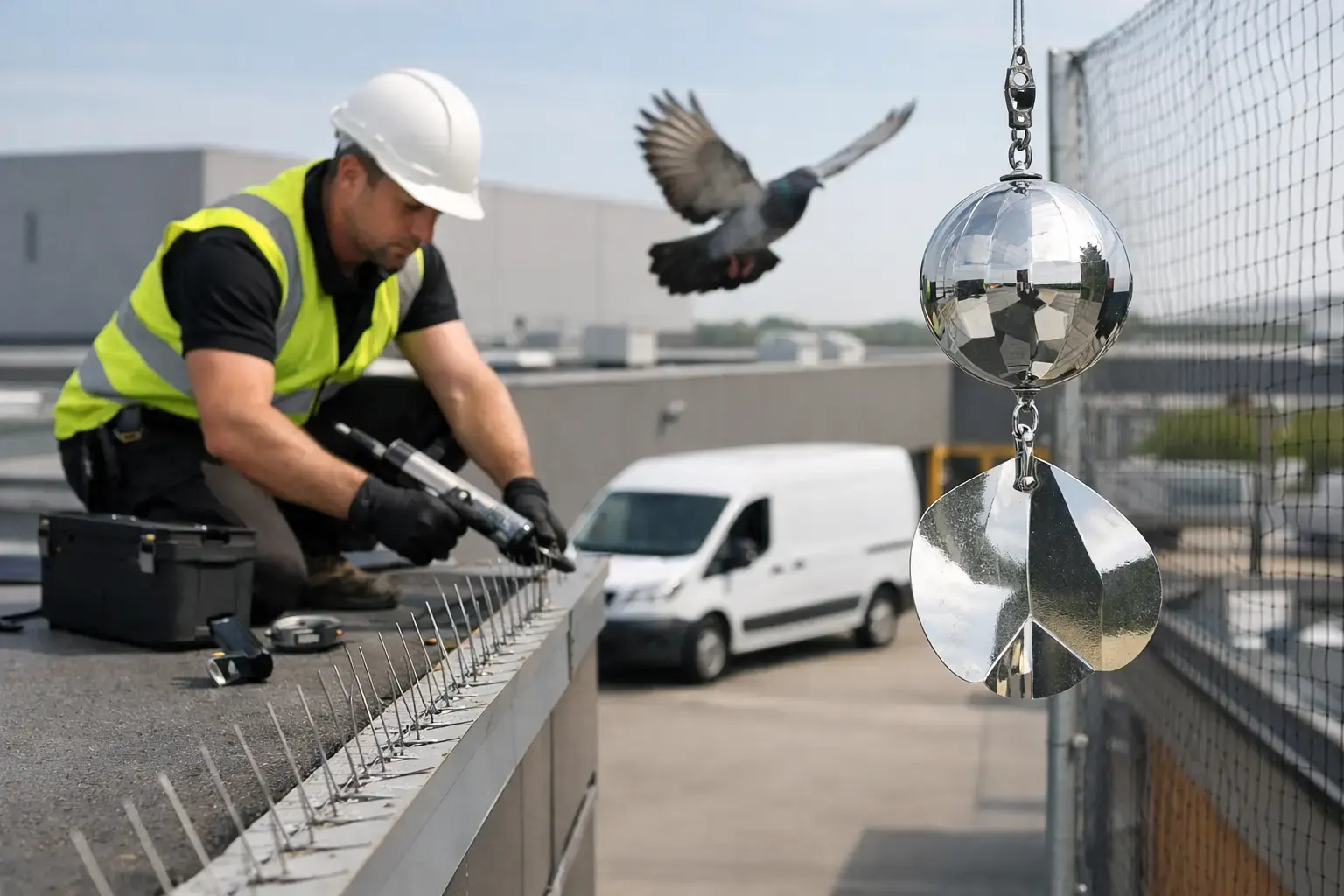
A few pigeons on a roofline can turn into a costly site problem faster than most managers expect. Droppings damage surfaces, nesting blocks gutters, noise affects staff and customers, and repeated bird activity can put hygiene, safety and reputation at risk. The best commercial bird deterrent methods are the ones that match the building, the bird pressure and the way the site is used day to day.
For commercial premises, there is no single fix that works everywhere. A warehouse with steel cladding needs a different approach from a school, retail unit, office block or food handling site. Good bird control starts with understanding why birds are choosing the property in the first place, then using the right physical deterrents, proofing measures and monitoring to stop the problem from returning.
What makes a bird deterrent effective in commercial settings
The best results come from methods that do two jobs at once. First, they make the site less attractive for roosting, nesting or feeding. Second, they reduce the chance of birds simply moving a few metres away and carrying on elsewhere on the building.
That is why short-term scare tactics often disappoint on commercial sites. Birds quickly get used to anything that does not physically prevent access or change the environment in a meaningful way. A proper solution needs to consider ledges, parapets, roof voids, loading bays, signage, solar panels and any hidden access points. It also needs to take account of wildlife legislation, health and safety, and whether work can be carried out with minimal disruption.
In practice, the strongest commercial bird control plans use a combination of deterrence and exclusion. The right mix depends on species, building type, footfall and budget.
Best commercial bird deterrent methods for long-term control
Bird netting
Bird netting is one of the most effective options where complete exclusion is needed. It is commonly used on roofs, service yards, plant areas, loading bays, canopies and internal warehouse spaces where birds are entering through open structural gaps.
When installed correctly, netting creates a physical barrier that prevents birds from accessing favoured roosting and nesting areas. It is particularly useful on larger commercial buildings because it protects wide areas rather than isolated ledges. The trade-off is appearance and access. On some front-facing elevations or architecturally sensitive buildings, netting may not be the most discreet option. It also needs proper tensioning, fixings and regular inspection. Poorly fitted netting can sag, fail early or create welfare issues.
Bird spikes
Bird spikes remain a practical choice for ledges, beams, signs, cills and parapet walls. They work by making it uncomfortable or impossible for larger pest birds such as pigeons to land and settle.
Spikes are cost-effective and relatively unobtrusive when fitted properly, but they are not suitable everywhere. Wide ledges often need multiple rows, and uneven surfaces can leave gaps that birds exploit. They are also not designed for every species. On commercial sites with heavy gull pressure, for example, spikes alone may not be enough. Installation quality matters just as much as the product itself.
Post and wire systems
For buildings where appearance matters, post and wire systems can be a better fit than spikes. These systems create an unstable landing point along ledges and architectural features, discouraging birds from perching without altering the look of the building too heavily.
They are often used on offices, hotels, heritage-sensitive properties and customer-facing premises. The advantage is discretion. The limitation is that they suit specific ledge profiles and moderate bird pressure better than heavily infested areas. If there is an established nesting problem, post and wire may need to be part of a wider programme rather than the only measure.
Mesh proofing for plant and roof voids
Many bird problems start in hidden spaces rather than on visible ledges. Roof voids, plant equipment, solar panel arrays and service openings can all provide shelter. Mesh proofing is often the best answer where birds are getting into these spaces and causing ongoing contamination or damage.
This method is less about deterring birds from landing and more about denying access altogether. It is especially useful where repeated cleaning has failed because the root cause has never been removed. If birds can still get behind fascia boards, under panels or into rooftop plant areas, the problem will continue.
Avian gel and low-profile ledge systems
On certain commercial sites, low-profile deterrents such as avian gel dishes or specialist ledge barriers can play a role. These are usually chosen where visual impact must be kept to a minimum.
They can be useful in light-pressure areas, but they are not a cure-all. Gels need correct placement and periodic replacement. If the site has a high level of bird activity, a more durable exclusion method is usually better value over time.
Methods that can help, but rarely solve the problem alone
Visual scarers, reflective devices and predator decoys are often the first things businesses try because they seem simple. The problem is that pest birds are highly adaptable. If a decoy hawk sits in the same position for days, or reflective tape never changes, birds learn very quickly that there is no real threat.
Sound deterrents can have some value in specific situations, particularly on large open sites away from the public. Even then, they need careful management. In busy commercial environments, excessive noise can create complaints long before it solves a bird issue.
That does not mean these methods are useless. They can support a wider strategy, especially during the early stage of control or where bird pressure is seasonal. But if droppings, nesting and roosting are already established, physical proofing is usually the method that delivers lasting results.
How to choose the best commercial bird deterrent methods for your site
Start with the species. Pigeons, gulls and small pest birds behave differently, use buildings differently and respond to different control methods. Then look at where the activity is happening. A problem focused on shop signage is not treated in the same way as birds entering a warehouse roof space.
You also need to think about the consequences of getting it wrong. On food premises, healthcare sites, schools and hospitality settings, bird activity can quickly become a compliance and reputation issue. In those cases, speed matters, but so does choosing a method that stands up over time.
Access is another deciding factor. Some buildings allow straightforward installation from fixed access points. Others need specialist working at height equipment or a UAV survey to properly identify entry routes and pressure points before work begins. A proper survey often saves money because it stops you treating the visible symptoms while missing the real source of the problem.
Budget matters too, but cheapest rarely means best. A low-cost deterrent that fails within months or only shifts birds to another part of the building is not economical. Commercial clients usually get better value from a system designed around prevention, cleaning requirements and future maintenance rather than a one-off reaction.
Compliance, safety and bird welfare
Commercial bird control has to be carried out properly. Many bird species, nests and eggs are protected by law, and any work must reflect that. This is one reason site-specific assessment is so important. Timing, species identification and method selection all matter.
Health and safety is equally important. Bird droppings can create slip hazards and contamination risks, especially around entrances, fire escapes, plant areas and delivery points. At height, poor installation introduces its own hazards. Safe access planning and competent fitting are part of the solution, not an optional extra.
A responsible approach also considers welfare. Effective bird control is not about causing harm. It is about preventing access, discouraging roosting and managing the site in a way that stops conflict between birds and the building.
Why commercial bird control often fails
Most failed jobs have one thing in common: the method was chosen before the site was properly assessed. Spikes are fitted to one ledge while birds are nesting under the roof sheets. A decoy is placed on a parapet while food waste around the bins continues to attract activity. Netting is installed, but access points at the edges are left open.
The other common issue is poor maintenance. Even the best commercial bird deterrent methods need checking over time. Fixings can loosen, site use can change and new access routes can appear after roofing works or building alterations. Commercial properties are not static, so bird control should not be treated as static either.
For businesses in Stockport and across the surrounding area, the most reliable route is a tailored survey, clear specification and professional installation that fits the building and the level of pressure. When bird control is approached that way, it protects the site, reduces recurring costs and avoids the cycle of temporary fixes. If birds are already starting to claim space on your premises, acting early is usually the cheapest decision you will make.