

Blog
Professional or DIY Wasp Removal?
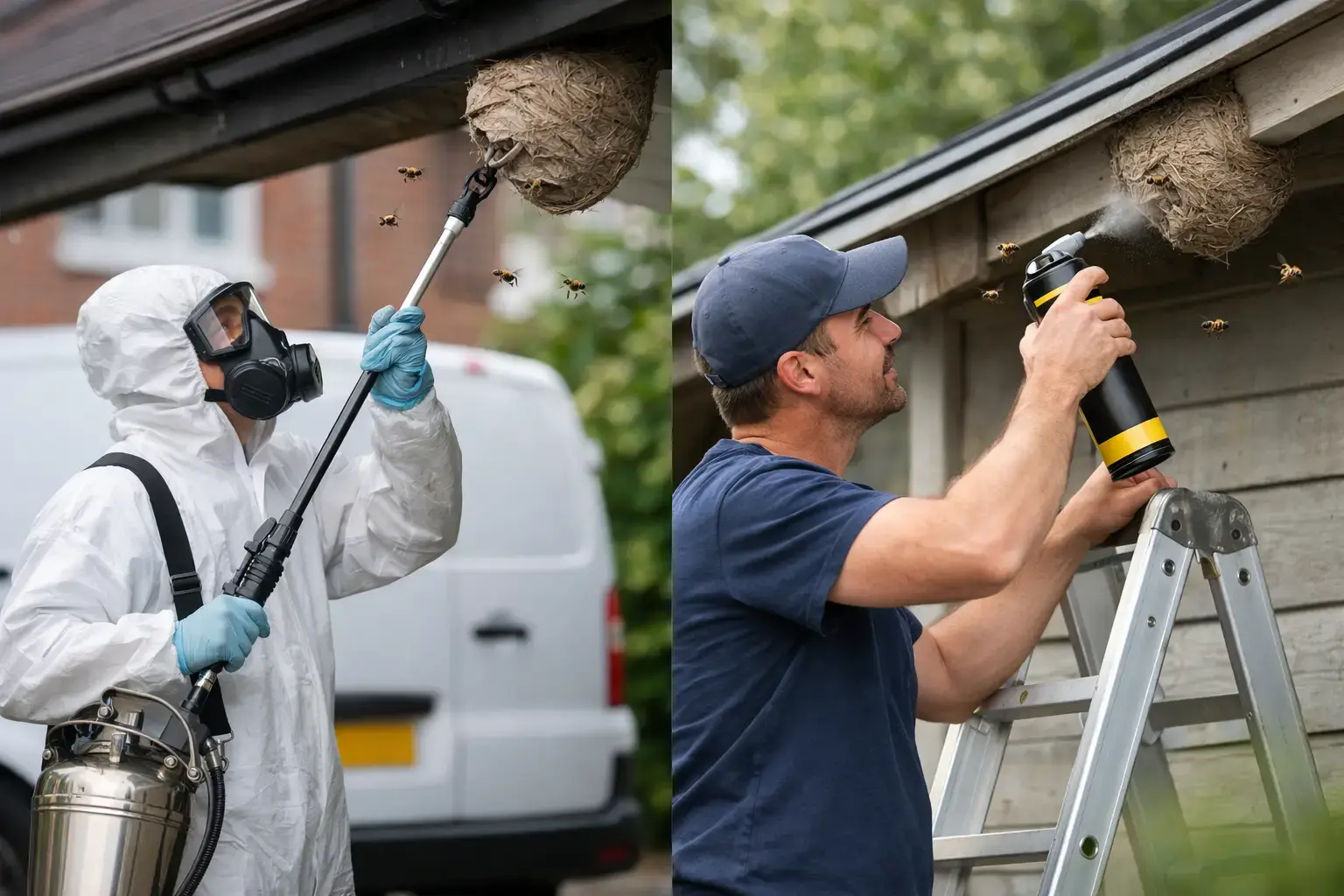
The buzz usually starts before you see the nest. A steady stream of wasps around the eaves, loft vent, shed roof or wall cavity is often the first sign that the problem is already established. When that happens, the question is usually immediate - professional or DIY wasp removal?
For some people, the temptation is to deal with it themselves and save the cost of a call-out. That can work in very limited situations. But with wasps, the real issue is not whether you can reach the nest. It is whether you can treat it properly, without driving aggressive insects back into the property or putting yourself at risk.
Professional or DIY wasp removal - what actually changes?
The biggest difference is control. A professional treatment is built around identifying the species, locating the true nest position, choosing the right product and applying it safely so the colony is eliminated. DIY treatment often focuses on what is visible from the outside, which is where many jobs go wrong.
A wasp nest can sit inside a loft, behind soffits, under roof tiles, in cavity walls, air bricks, garages, garden buildings and dense shrubs. The visible flight path may only show the entry point, not the full nest. If you spray the wrong area or block the entrance too soon, wasps can force a new route out. That may mean they appear indoors, in bedrooms, bathrooms or roof spaces where they were not seen before.
That is why a simple-looking nest is not always simple. Good results depend on access, timing, product choice and an understanding of wasp behaviour once the nest is disturbed.
When DIY wasp removal may be reasonable
There are cases where a careful householder may decide to handle it. If the nest is very small, clearly visible, easy to access from ground level and well away from doors, windows, children and pets, a shop-bought treatment may deal with it.
Even then, there are limits. You need the confidence to identify that it is a wasp nest rather than bees, and you need to read the product guidance properly. The treatment should be suitable for the location, especially around buildings, gardens and enclosed spaces. You also need a clear retreat route. Wasps do not always react instantly, but when they do, they can be aggressive in numbers.
DIY is more likely to be considered where the nest is newly formed and external, such as under a small overhang or in a detached outbuilding. It is far less suitable where the nest is hidden, overhead or positioned close to routine foot traffic.
When professional wasp removal is the safer option
If the nest is in the loft, roofline, cavity wall, chimney, soffit, hedge, tree, compost area or any elevated position, professional treatment is usually the sensible route. The same applies if you have had repeated wasp activity, if someone at the property is allergic to stings, or if the nest is near customer areas, entrances, schools, care settings or workspaces.
Commercial sites in particular have less room for trial and error. A poorly handled nest near an outdoor seating area, loading bay, bin store or office entrance can quickly become a health and safety issue. Landlords and property managers also need confidence that the problem has been treated correctly and not just temporarily suppressed.
There is also the practical point that many DIY attempts happen after dark or at awkward angles using ladders. That combination of height, low visibility and defensive insects is where avoidable accidents happen. In those cases, the cost saving is rarely worth the risk.
The risks people often underestimate
Wasps are not automatically aggressive at a distance, but they defend the nest decisively when they detect vibration, movement or chemical disturbance. A single nest can contain a surprisingly high number of workers by late summer. Once disturbed, they can emerge quickly and in large numbers.
The first risk is stings. For most people, that means pain and swelling. For others, it can mean a serious allergic reaction requiring urgent medical attention. The second risk is incomplete treatment. If the nest survives, activity continues. The third risk is displacement. A blocked or partially treated nest may push wasps deeper into wall voids or into internal rooms.
There is also a species issue. People sometimes confuse wasps with bees or hornets, and treatment should not start until that distinction is clear. Bee issues need a different approach, and misidentification can create unnecessary harm and a bigger problem to solve afterwards.
Why some DIY treatments fail
Most failed DIY jobs come down to one of three things. The first is poor access. If you cannot apply treatment directly where the wasps are entering and the nest is hidden deeper inside, the product may not reach the colony. The second is timing. Treating during peak activity without proper positioning can agitate the nest before enough product has been delivered. The third is underestimating nest size.
There is also a common mistake of sealing holes immediately after treatment. That sounds logical, but if any wasps remain active inside, they may search for another route out. In a house, that can mean they appear through light fittings, vents, loft hatches or gaps around pipework.
Professional treatment is not just about stronger products. It is about using them with a plan. That is what makes the difference between short-term disruption and full nest control.
What to expect from professional wasp removal
A proper service starts with assessment. The operative confirms whether the activity is from wasps, where the access point is, how the nest is likely positioned and whether there are any complications inside the structure. Treatment is then chosen to suit the site rather than forcing a one-size-fits-all approach.
For domestic properties, that usually means targeted nest treatment with advice on what activity to expect afterwards. You may still see wasps returning for a period, because foraging workers come back to the site before the colony fully collapses. That does not necessarily mean the treatment has failed.
For commercial settings, the process should also account for access, discretion and site safety. Where business reputation matters, the job needs to be handled quickly and with minimal disruption. That is particularly important for food premises, hospitality, education and public-facing sites.
A specialist firm such as AZ Environmental Service Pest Control will also advise when further proofing is appropriate. Not every nest requires follow-up works, but if access points, gaps or recurring attractants remain, prevention matters.
DIY or professional wasp removal for recurring problems
If wasps seem to return year after year, the answer is rarely just another spray. Recurrent activity usually points to a property feature that makes the site attractive - sheltered roof voids, unsealed gaps, damaged vents, old nest sites, warm loft spaces or easy access around outbuildings.
This is where professional input has more value than a single treatment. Solving the immediate nest is one part of the job. Reducing the chance of another nest in the same area is the longer-term fix. That may involve identifying vulnerable entry points, checking lofts and cavities, and advising on practical proofing measures.
It depends on the building. A detached house with a busy loft space needs a different approach from a commercial unit with cladding gaps or service voids. The treatment may be quick, but the thinking behind it should be site-specific.
How to decide quickly and sensibly
A good rule is this: if you can treat the nest safely from the ground, it is clearly visible, small, external and far from people, DIY may be an option. If any of those points are missing, professional treatment is usually the better decision.
If the nest is high up, hidden, inside the structure, close to regular activity, or linked to a vulnerable person or business environment, expert help is the safer route. The same applies if you are not completely certain what insect you are dealing with.
Fast decisions matter with wasps because nests expand through the season. A problem that feels manageable in early summer can become a serious nuisance by late summer, especially around homes with children, outdoor seating areas, bin stores and warm roof spaces.
The right answer is not always the cheapest first step. It is the option that resolves the nest properly, keeps people safe and avoids turning one access point into a wider property issue.
If you are weighing up professional or DIY wasp removal, be honest about the location, the risk and the likely outcome. With wasps, confidence is useful, but accurate treatment is what solves the problem.