

Blog
Bird Netting vs Spikes: Which Works Best?
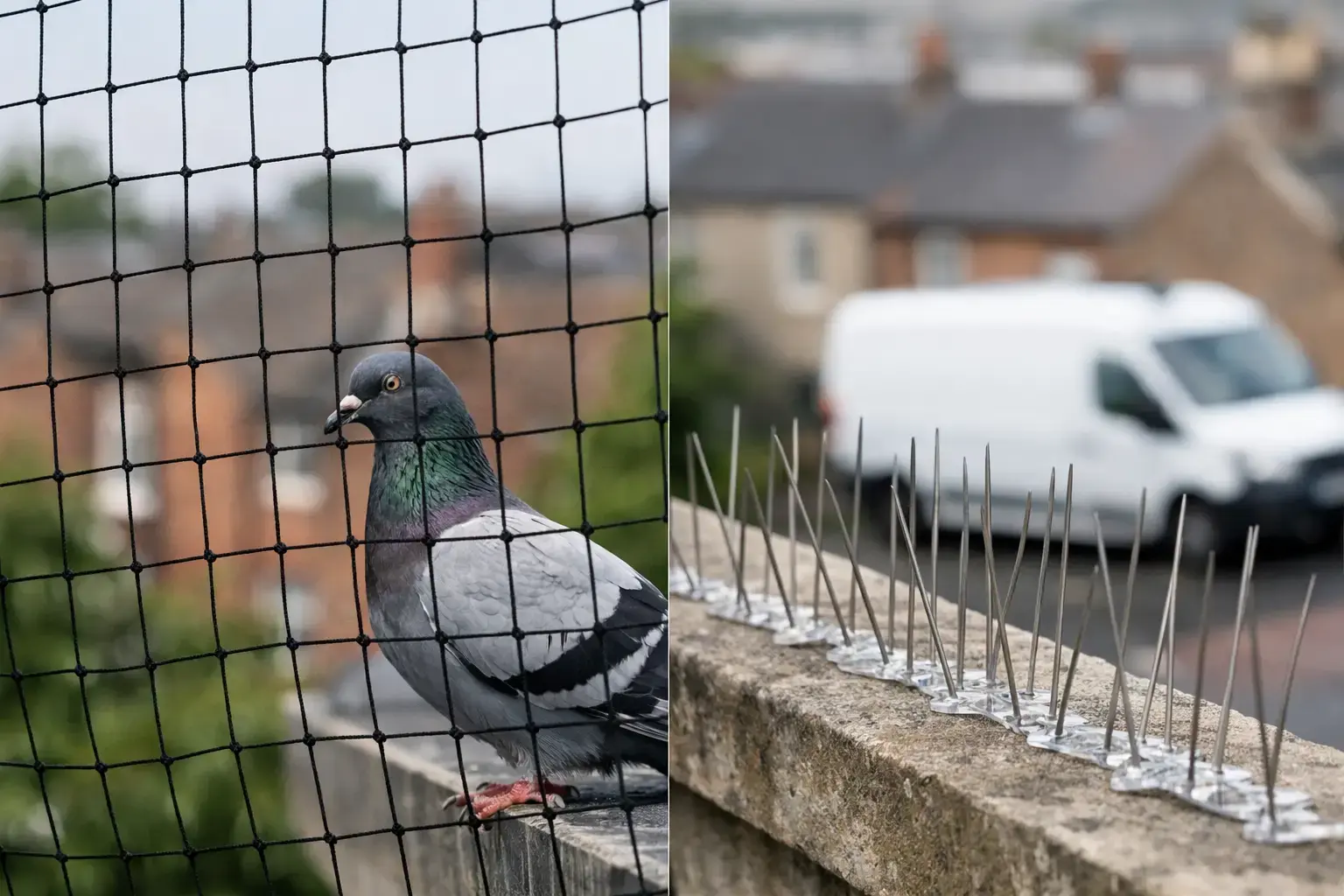
If pigeons are fouling your shopfront every morning or gulls keep returning to your roofline, the wrong deterrent wastes time and money. When clients ask about bird netting vs spikes, they usually want a clear answer fast - which one actually stops the problem, and which one simply shifts it a few feet along the building?
The honest answer is that both systems can work well, but they do very different jobs. The right choice depends on where birds are landing, how large the affected area is, what the building looks like, and whether you need full exclusion or just landing prevention. A proper recommendation should be based on the site, not a one-size-fits-all product.
Bird netting vs spikes: the main difference
Bird spikes are a landing deterrent. They make ledges, signs, beams and similar narrow surfaces uncomfortable for birds to perch on. They do not trap birds, and when correctly installed they encourage them to move elsewhere.
Bird netting is an exclusion system. It creates a physical barrier that stops birds accessing a larger area in the first place. That could be a canopy, loading bay, warehouse roof void, balcony, lightwell or courtyard. Where spikes deal with specific perching points, netting deals with access to a zone.
That distinction matters. If birds are simply lining up along a narrow parapet, spikes may be enough. If they are flying into a recessed area to roost or nest, spikes alone are unlikely to solve it.
When bird spikes are the better option
Spikes are often the most practical answer on relatively small, defined landing areas. Typical examples include window ledges, wall tops, signs, CCTV cameras, external lighting and pipework. On buildings where pigeons repeatedly perch in the same places, spikes can give a fast and tidy result.
They also tend to be less visually intrusive than many people expect, particularly when matched carefully to the structure. On a straightforward domestic property or a commercial frontage, they can be installed with minimal disruption and without changing the overall appearance of the building too much.
Cost is another reason spikes are commonly chosen. For isolated problem points, they are usually more affordable than netting. If a landlord wants to stop fouling above a doorway or a business needs to protect a sign above customer access, spikes can be a sensible, proportionate solution.
That said, spikes are only effective when the target surface is suitable. If the ledge is too wide, birds may simply nest between rows or settle on an untreated section nearby. If there are multiple approach angles or connected surfaces, poor planning can leave obvious gaps.
Where spikes can fall short
Spikes do not enclose space. If birds are entering a sheltered recess, roof valley or steel framework, spikes may reduce perching in one spot while leaving the main roosting problem untouched. They can also become ineffective when installed on dirty surfaces, badly spaced sections or awkward architecture.
This is where many failed bird control jobs start. A few strips get fitted to the most visible ledge, but the birds were never dependent on that one ledge in the first place.
When bird netting is the better option
Netting is usually the stronger solution where birds are roosting, nesting or flying into a larger area repeatedly. It is particularly effective for warehouses, retail units, schools, industrial sites, solar panel areas, balconies and undercroft spaces where birds use the same sheltered zone day after day.
The main advantage is coverage. A properly designed netting system blocks access across the whole opening or void, rather than trying to deter individual landing points one by one. That makes it much more reliable for persistent infestations or larger commercial premises.
For property managers, netting often makes sense where hygiene, safety and maintenance costs are becoming serious issues. Bird fouling creates slip risks, damages surfaces, blocks gutters and creates an obvious reputational problem around entrances, courtyards and service areas. In those cases, exclusion is often the most effective long-term fix.
Where netting can fall short
Netting is not always the neatest option visually, and it needs to be installed correctly to avoid sagging, gaps or unnecessary strain on the structure. On heritage buildings or highly visible front elevations, appearance may be a bigger consideration.
It is also usually more involved than fitting spikes. Larger installations require proper surveying, correct tensioning and secure fixing points. If the area includes height access issues, fragile roofing or complex steelwork, the job becomes more technical. Done well, netting is highly effective. Done badly, it quickly becomes a maintenance problem.
Which lasts longer?
In terms of service life, both can last well if the right materials are used and the installation is site-specific. Stainless steel spikes on suitable surfaces can remain effective for years. Quality netting systems can also perform very well over the long term, especially where the fixings, cable framework and net grade match the location.
The bigger factor is not the product itself but the design and fitting. Coastal exposure, heavy fouling, UV exposure, building movement and access for maintenance all affect durability. A cheap install is often what fails first.
For that reason, long-term value should be judged on performance, not just the initial invoice. A lower-cost deterrent that does not solve the bird activity is not cheaper in any meaningful sense.
Bird netting vs spikes for homes and businesses
For homeowners, spikes are often enough when the issue is limited to chimney pots, fence tops, porch roofs or window ledges. If the problem is localised and the birds are using obvious perching points, spikes can be a clean and effective answer.
For landlords and commercial operators, the decision is often more operational. If birds are affecting staff entrances, customer areas, plant equipment or stock storage zones, the risk goes beyond annoyance. Fouling, noise, nesting debris and ongoing clean-up costs all need to be considered. In those settings, netting is more likely to be justified where access to a larger area needs to be blocked completely.
On mixed-use buildings, the best result may involve both. Spikes can protect exposed ledges and signage, while netting seals off sheltered voids where birds are roosting. Good bird control is often about combining methods properly rather than forcing one product to do everything.
What about humane and legal considerations?
Any professional bird control work needs to be wildlife-conscious and legally compliant. Timing matters, especially during nesting season. Protected species and active nests cannot simply be disturbed because they are inconvenient.
That is another reason a site survey matters. Before recommending bird netting vs spikes, the real issue must be identified - species, behaviour, nesting activity and the exact points of access. Humane bird control is not just about the product chosen. It is about using the correct method at the correct time, with the correct safeguards.
How to choose the right system
Start with the behaviour, not the product. Ask where the birds are landing, where they are entering, whether they are nesting, and how much of the structure is affected. A narrow ledge problem points one way. A sheltered access problem points another.
Then look at the building itself. Visibility, access, height, maintenance requirements and the type of surface all matter. A retail frontage in a busy area may need a discreet finish. An industrial unit may need broad exclusion across a high-risk zone. The best option is the one that solves the problem fully without creating unnecessary visual or maintenance issues.
On many sites across Stockport and surrounding areas, what looks like a simple pigeon problem from ground level turns out to be a more complex access issue once surveyed properly. That is why technical assessment matters. The most effective bird control work is planned around how birds are using the building, not just where the mess is most visible.
If you are weighing up bird netting vs spikes, think beyond the product brochure. The right system is the one that fits the structure, stops the behaviour and keeps the issue from returning. A reliable solution should leave you with fewer call-backs, less cleaning and a building that works as it should.