

Blog
Best Pigeon Deterrents for Roofs That Work
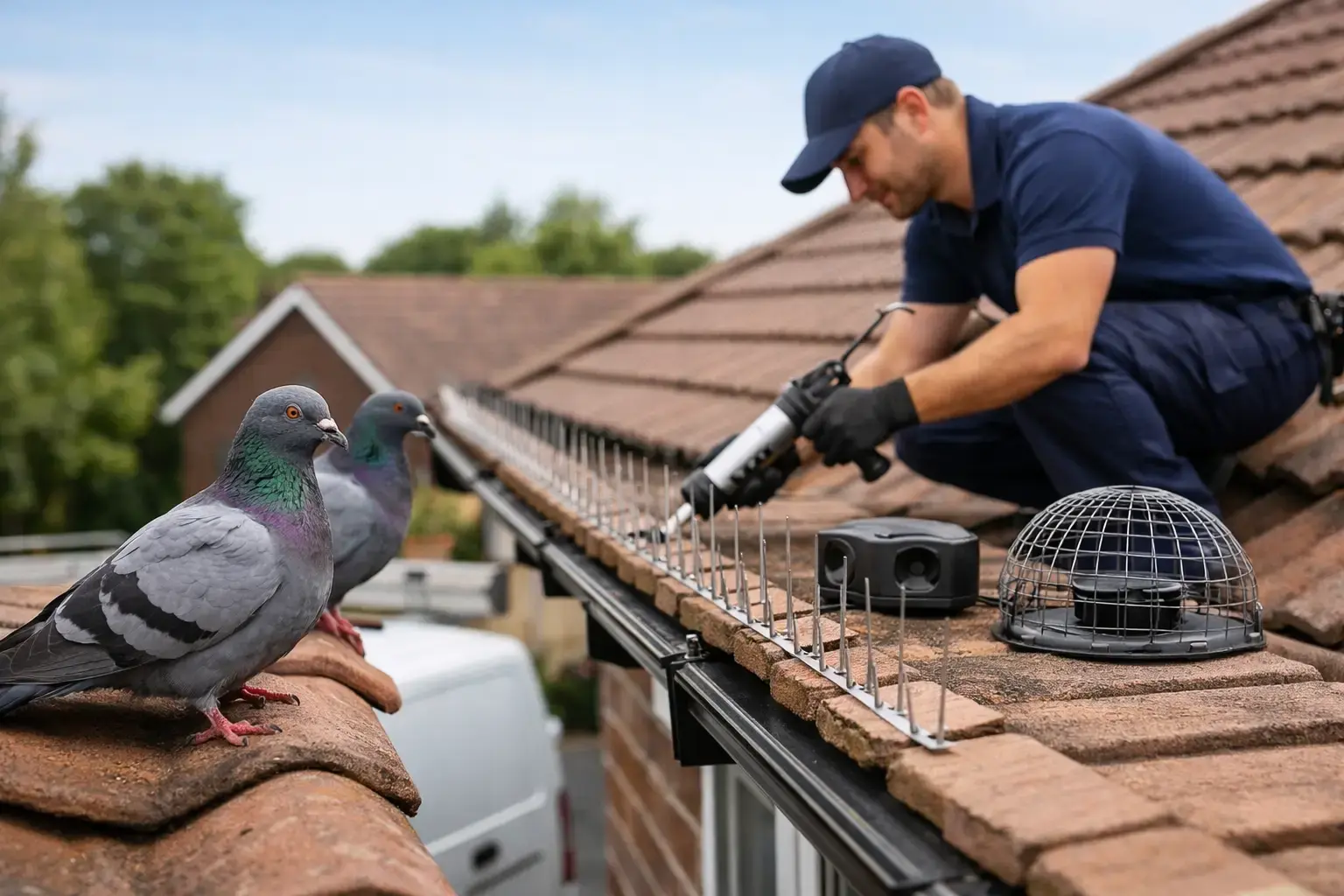
A few pigeons on a ridge tile can quickly become a costly roof problem. Droppings block gutters, foul solar panels and create slippery surfaces, while nesting material can obstruct drainage and attract insects. The best pigeon deterrents for roofs do more than move birds along for a day or two - they prevent landing, nesting and access without creating a new maintenance issue.
The right option depends on where pigeons are sitting, how they get onto the roof and whether the building is a house, block of flats, warehouse or retail premises. A proper inspection is the starting point. Fitting a deterrent to the wrong area may leave the real access point untouched.
What makes a roof pigeon deterrent effective?
Pigeons return to reliable roosting sites because they feel secure there. They favour sheltered ledges, chimney stacks, parapet walls, solar-panel edges and gaps beneath roof structures. An effective control measure removes that certainty by physically denying access or making the landing point unsuitable.
Visual decoys, reflective discs and ultrasonic devices are often bought as quick fixes. In exposed locations they may have a brief effect, but pigeons are highly adaptable. Once they learn there is no genuine threat, they normally return. They can also be unreliable in the wind and look out of place on a well-kept property.
Long-term results usually come from professionally fitted physical proofing. The system must be appropriate for the surface, securely installed and designed not to damage tiles, flashings, gutters or the building's appearance.
The best pigeon deterrents for roofs
Bird netting for large or awkward areas
Bird netting is often the most dependable answer for open roof voids, loading canopies, covered yards, plant areas and balcony recesses. Correctly tensioned netting creates a complete barrier, stopping pigeons from entering a protected space rather than simply shifting them to the next ledge.
It is particularly effective for commercial premises where bird activity risks contamination, complaints or damage to stock and equipment. The trade-off is visual impact: netting must be installed neatly, with the right mesh size, framing and tension, or it can sag and collect debris. Poorly fitted netting can also trap birds, which is why installation quality matters.
Pigeon spikes for ledges, sills and gutter lines
Spikes are a practical choice for narrow, defined landing areas. They work well on chimney pots, ridge tiles, parapets, signs, window ledges, gutter edges and pipework. A correctly selected spike system prevents a pigeon from landing comfortably, encouraging it to move elsewhere.
Not all spikes suit every roof. Wide ledges may require multiple rows, while a deep recess may be better protected with netting or wire. Cheap plastic spikes can become brittle, and poorly bonded strips can lift in bad weather. Durable stainless-steel systems, installed with appropriate fixings, are generally the better long-term option.
Spikes do not solve access beneath solar panels or into loft voids. They are a targeted landing deterrent, not a complete proofing system.
Post-and-wire systems for discreet protection
Post-and-wire deterrents use fine tensioned wires supported by low-profile posts. They are suitable for heritage-sensitive buildings, shopfronts, parapets and visible ledges where a less obvious finish is required. The wires create an unstable landing point while preserving a cleaner appearance than spikes.
This is a precise system. Wire height, spacing and tension all need to match the target bird and the ledge dimensions. It can be highly effective on suitable surfaces, but it is not designed for heavily cluttered roofs, broad nesting areas or places where pigeons can simply land behind the wires.
Solar panel bird proofing
The gap between solar panels and the roof is an ideal nesting site. It is warm, sheltered and difficult to reach once birds have settled in. Nesting material beneath panels can restrict airflow, create a fire risk where debris builds up and lead to persistent noise above living spaces.
Solar-panel proofing uses a purpose-made mesh fixed around the panel perimeter. It prevents access underneath while allowing ventilation to continue. The mesh should be fitted without drilling into panels or affecting the roof covering. Before proofing begins, any nesting material and contamination need to be dealt with safely and the area checked for active nests.
Exclusion and roof-gap proofing
Sometimes the most effective pigeon control is not a visible deterrent at all. Missing tiles, gaps at eaves, damaged soffits, open chimney pots and loose flashing can give pigeons access to roof voids. Once inside, they may nest repeatedly and leave droppings in loft insulation.
Exclusion work closes these access points with suitable mesh, caps or repair materials. It should allow necessary ventilation while preventing birds from re-entering. This is often combined with spikes or netting where pigeons are also roosting externally.
Choosing the right solution for your property
Start by identifying the activity. Birds perched on a chimney need a different measure from birds nesting under solar panels or entering a warehouse canopy. Look for droppings, feathers, nest material, blocked gutters and repeated activity at the same time each day. These signs help identify both the roost and the approach route.
For a typical home, solar-panel mesh, chimney protection and selective spikes are often enough. For landlords and managing agents, the priority may be protecting communal areas, roof drainage and balconies without making the building look over-treated. Commercial sites often need more comprehensive netting and a documented maintenance approach, particularly around food handling, staff entrances and customer-facing areas.
Roof access is also a safety issue. Steep pitches, fragile materials and high-level commercial buildings are not suitable for improvised work. A professional survey, including UAV inspection where appropriate, can identify nesting points and roof defects without unnecessary working at height.
Avoid deterrents that create bigger problems
Bird-control gels can look like an easy option, but exposed gel can catch dust, leaves and feathers. This leaves an unsightly surface and may require difficult cleaning later. Loose mesh, cable ties and home-made barriers are also poor choices: they can fail in strong weather, damage roof finishes or create an entanglement hazard.
Avoid poisoning or attempting to remove birds yourself. Apart from the safety and welfare concerns, this does not address the conditions that attracted pigeons in the first place. The next birds can simply occupy the same protected area.
Active nests, eggs and dependent young require particular care. Roof work should be planned around nesting activity, and any bird-control work must be carried out lawfully and responsibly. A site assessment helps establish the right timing and the safest method.
Installation and maintenance matter as much as the product
Even the strongest deterrent will underperform if it is installed over old nest debris or leaves gaps at the edges. Before fitting proofing, remove accumulated material where it is safe and appropriate, clean affected surfaces and inspect gutters, tiles and fixings. This gives the system a sound base and removes the scent and material that can encourage birds to return.
After installation, periodic checks are sensible. Severe weather, building repairs and gutter cleaning can affect fixings. Netting should remain taut, spikes should be secure and solar-panel mesh should stay flush to the roofline. Early maintenance is far less expensive than allowing a small failure to become another nesting route.
For properties in Stockport and across Greater Manchester, AZ Environmental Service Pest Control can assess the bird pressure, roof layout and access risks before recommending a tailored, wildlife-conscious solution. The aim is not to fit the most visible product. It is to stop pigeons returning and protect the building for the long term.
A roof should shed rain, not harbour birds. When the deterrent matches the problem and is fitted properly, pigeon activity can be stopped without repeated short-term fixes.